
3.1.8 The Correlation Machine: Engineering Trust at the Digital Border


The Final Briefing
For the past few posts, we have followed Aaron’s attempt to infiltrate Evently. We’ve watched him hide his location, disguise his device, compromise machines and buy aged identities with history. Each layer of defense was just another obstacle to clear.
But modern fraud prevention is not a checklist.
It is a Correlation Machine.
A fraud engine does not ask:
“Is this IP clean?”
“Is this device new?”
“Is this email old?”
It asks something more powerful:
Do all of these signals agree with each other?
When they don’t, we find the Flicker.
The Signal Symphony: What We’ve Captured
At the moment Aaron clicks “Create Account,” Evently’s system captures a multi-dimensional snapshot of his reality.
Not one signal.
Not one score.
But a layered trust profile across five domains:
Network - The Path: Was he on residential Wi-Fi or a data center ASN? Does the route look like a home or infrastructure built for scale?
Device - The Machine: Is this a persistent physical device with history? Or a virtual emulator trying to multiply itself?
Integrity - The Truth: Can we trust what the device is telling us? Or has the operating system been compromised to lie?
Identity - The Reputation: Does the email and phone number have Digital Exhaust? Or are they newly manufactured ghosts?
Behavior - The Human: Does the interaction carry human rhythm? Or does it move with synthetic precision?
Each layer filters noise. Together, they form the Trust Stack.
And like the layered funnels in the diagrams below, each stage narrows the field. Removing bots, farms, synthetic personas, and anomalies until only legitimate users pass through.
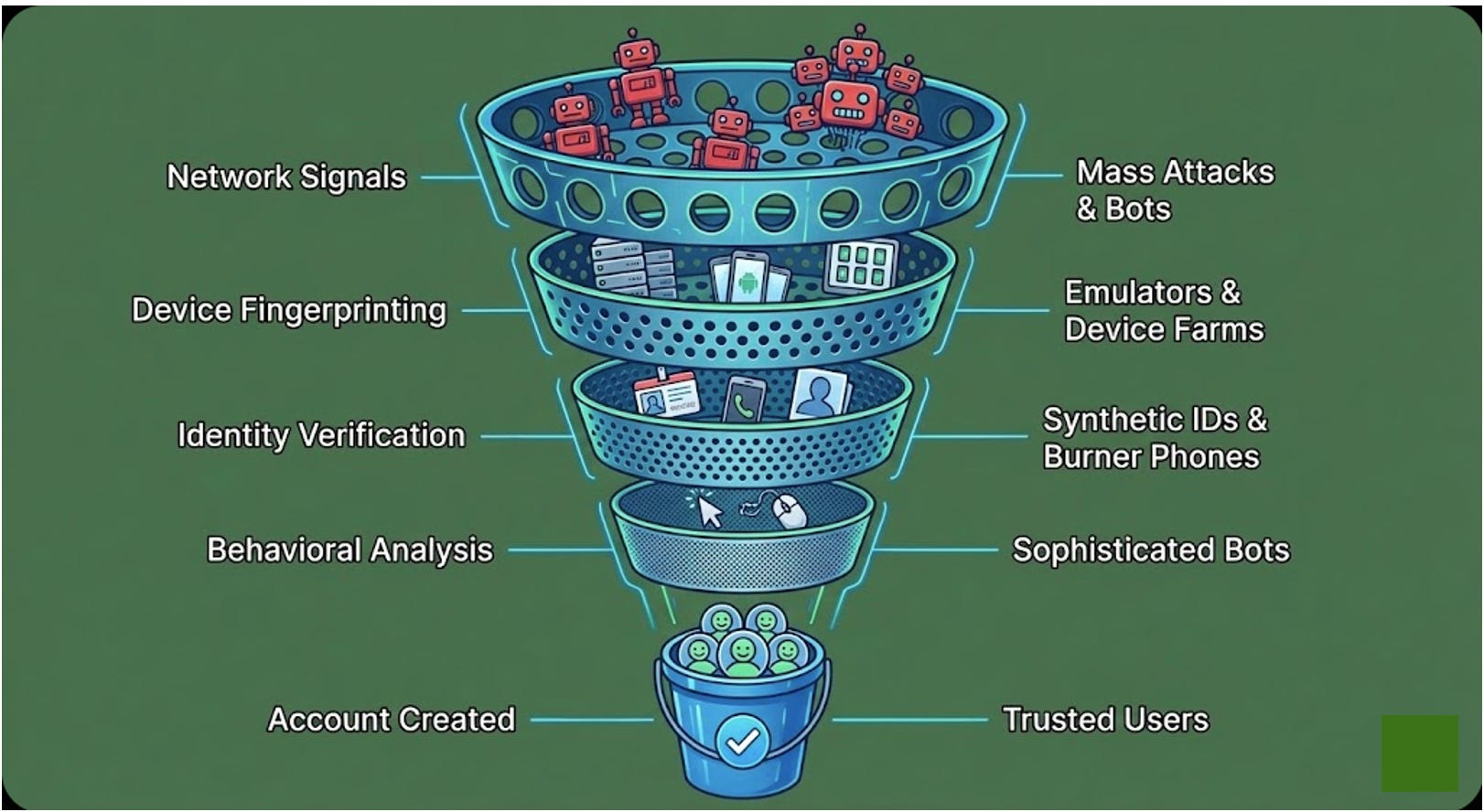
The Correlation Engine: Where Fraud Gets Caught
A single signal can be spoofed. Two signals can be purchased. Three signals can be engineered.
But correlation is exponentially harder to fake.
Examples:
A Miami phone number + Seattle IP + London device timezone
A 5-year-old Gmail + brand-new device + industrial ASN
Perfect typing cadence + zero sensor movement
None of these signals alone is proof. But together? They form a contradiction impossible to fake.
This is why modern fraud engines behave less like rule engines and more like orchestras.
The Invisible Shield: Balancing Friction and Growth
If a fraud team’s only goal was to stop Aaron, they would simply block everyone. But Evently isn’t a vault; it’s a business.
The Growth Team wants a frictionless “Welcome Mat” to acquire new fans, and
The Engineering Team wants a lightweight app with minimal latency (the delay between a user’s action and the system’s response).
The challenge of Deliberate Trust Design is capturing all five signals without the legitimate user ever feeling a “speed bump.” This requires a deep partnership between Fraud and Engineering.
1. Optimizing the RTT (Round-Trip Time)
In networking, RTT is the time it takes for a signal to go from the app to the server and for the decision to come back. If the RTT is too high, the app “lags,” and users walk away.
Strategy: High-performance teams use “Asynchronous Collection.” We don’t wait for the “Submit” button to start working. By the time the user finishes typing their password, the Network and Device signals have already been sent in the background and their risk score is being generated.
Result: The “lag time” for the final decision is stripped down to milliseconds, often less than 200ms, making the bouncer’s interrogation invisible to the fan.
2. Leveraging the Consortium: External Intelligence
While Behavior and Integrity are captured “On-Device,” a fraud team must leverage Data Consortiums for Network and Identity signals.
Logic: You might see an email address for the first time, but a global consortium has seen it 5,000 times across other retailers and sectors.
Strategy: By plugging into these shared databases, the fraud team can “borrow” the reputation of a user from the rest of the internet, allowing them to fast-track trusted fans instantly.
3. The Risk-Based Handshake
Instead of a “Block/Allow” binary, the team designs a Graduated Response:
The Fast Track (Green): Low-risk users move instantly.
The Challenge (Yellow): A tiny flicker triggers a CAPTCHA or 2FA.
The Hard Stop (Orange): High-risk signals (like an emulator with a stolen ID) trigger a manual review or ID upload.
The Takeaway: Fraud Prevention as a Growth Lever
Fraud prevention is not about building an impenetrable wall. It’s about intelligent filters separating trust from abuse in real time.
When executed correctly, it accelerates growth:
Spend acquisition budgets boldly
Offer higher-value promotions
Open “Fast Pass” lanes for trusted users
The Trust Stack fundamentally changes the game. With the “Digital Flicker” catching impostors in real time, teams can remove friction for legitimate users confidently. Fraud stops being a reactive defense; it becomes a system of advantage.
Closing the Account Creation Series
From IP to behavior, from device to identity, we’ve seen how trust is layered at the very first click. Account creation is more than a form, it’s the foundation of digital trust.
But Aaron’s story doesn’t end there.
With a portfolio of clean, aged accounts, he has options. He can purchase high-demand tickets and resell them later. He can sell the accounts themselves to other bad actors. Or someone else can compromise those accounts entirely.
And in each of those scenarios, the core question shifts. It’s no longer:
“Who are you?”
It becomes something far more complex, and far more critical
“Can we trust it’s really you?”
🚀 What’s Next
In our upcoming posts, we’ll step into the world of Login and Authentication, how fraudsters try to slip in after accounts are created, the tricks they use to bypass access controls, where companies quietly lose revenue, and what safeguards can be designed to verify users without frustrating the legitimate ones.
Because verifying identity is only half the battle.
The real challenge starts the moment a user hits “Login.”